

WHO WE ARE
The work no one counts still has a cost. We’re counting it, together.
For too long, women have been expected to carry work that companies depend on but rarely measure. The Tally measures the Hidden Tax of being a woman at work: uncounted labor, missed compensation, unequal expectations, and career friction employers rarely name, value, or pay for. Each woman gets an Equity File, a record of her contribution she can use. Every woman who joins helps build the evidence to challenge the system that kept that work invisible.
YOUR NEXT MOVE
The conversation changes when the work is visible.

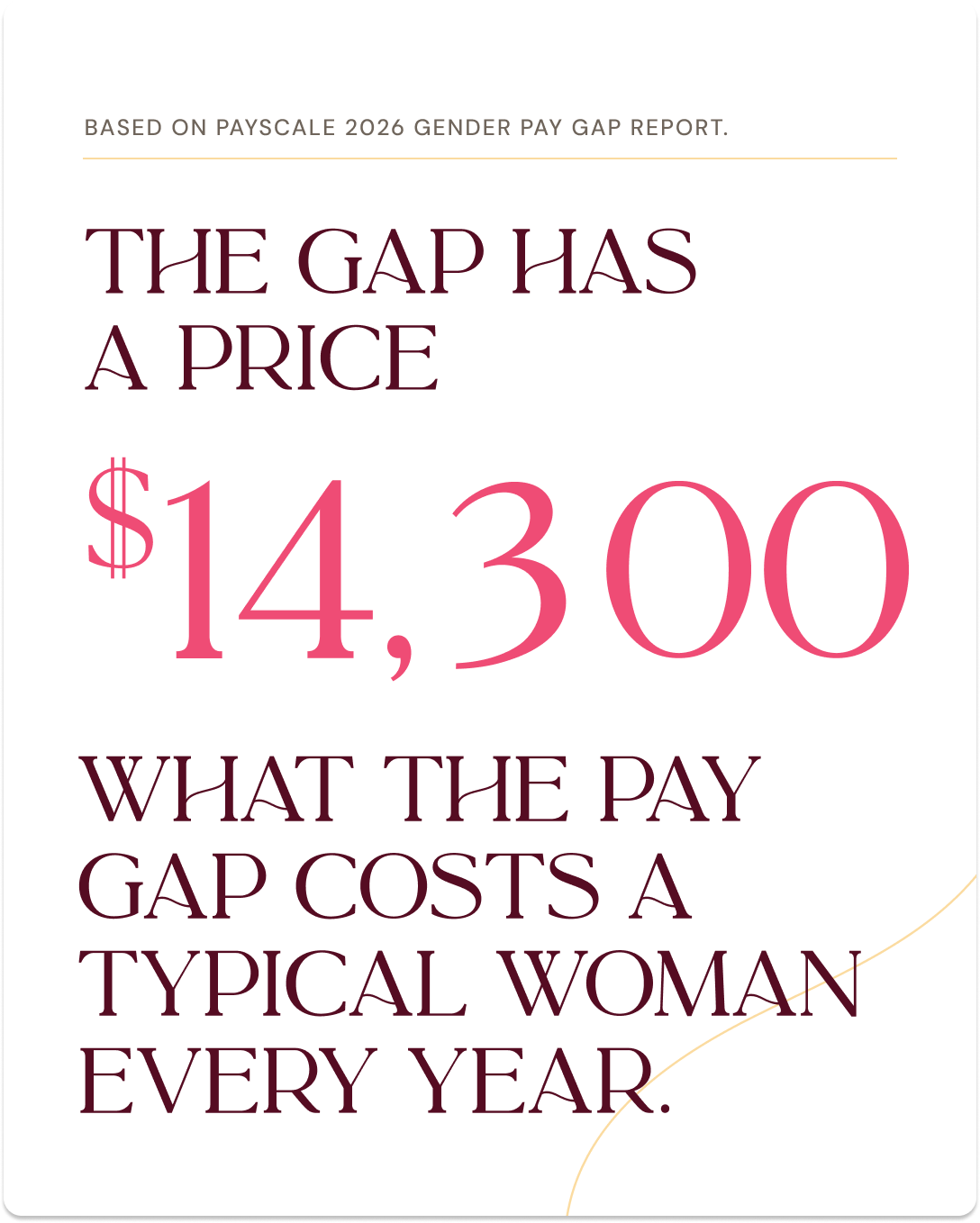
Payscale’s 2026 Gender Pay Gap Report found that women in the United States earn $0.82 for every dollar men earn in the uncontrolled gender pay gap, a $14,300 median annual difference. These population-level figures do not establish any individual’s gap. Pay is only part of it. Teams also depend on work that rarely appears in a title, compensation band, or review, and that work goes uncounted for women at every pay level.
THE PROBLEM
82¢
Women earn per $1
The average can describe a pattern. It cannot show you the work you are carrying.
Payscale’s 2026 Gender Pay Gap Report found that women in the United States earn $0.82 for every dollar men earn in the uncontrolled gender pay gap, a $14,300 median annual difference. Source. These population-level figures do not establish any individual’s gap. Pay is only part of it. Teams also depend on work that rarely appears in a title, compensation band, or review, and that work goes uncounted for women at every pay level.
WHAT THE TALLY DOES
60%
Of women have never negotiated their salary.
Data is the input.Agency is the product.
The Tally helps you put a value on the work your title, salary, and reviews don’t fully reflect, and keeps it from disappearing. Start with The Baseline for a first estimate. Join The Tally for your Equity File, a personal record you can use to prepare for a raise, review, promotion, or offer conversation.
DATA AND EVIDENCE
Personal data serves a personal purpose.Collective data serves a public one.
The Tally collects workplace information because the conditions of inequity are not abstract. Role, level, compensation, tenure, location, responsibilities, career movement, and extra labor influence how work is assigned, recognized, and rewarded. Individual information builds a personal tally and record. Aggregated information can show where patterns repeat, which kinds of labor are persistently under-credited, and where organizational design produces career drag, including for women who are well paid.
WHY IT’S BIGGER THAN ONE FILE
When one woman says she is carrying more than her role recognizes, it can be dismissed as one person’s experience. When the same work shows up in record after record, across roles, levels, and industries, it stops being anecdote. The Tally exists so that each woman can advocate for herself with evidence, and so that, together, those records can challenge how organizations assign, recognize, and reward work. The personal case and the collective case are built from the same material.
WHY THIS EXISTS
The Tally was built around a recurring workplace reality: women are often asked to carry work that matters to the organization but does not translate cleanly into compensation, credit, or advancement. It happens to women who are struggling and to women who are thriving. The company exists to give every woman a record of what she contributes, and to turn those records into the evidence needed to change the systems that keep treating essential work as invisible.
START WITH WHAT CAN BE NAMED
What has been hard to name can still be measured.
See your estimated workplace pay gap and the value of labor that has gone uncounted. Join The Tally for your Equity File, bring a clearer record of your work to your next conversation, and add your record to the evidence that this work counts.
LEADERSHIP
One founder lived the pattern.The other builds the measurement.
The Tally is led by a founder who spent two decades inside the conversations where women’s work and pay did not line up, and a co-founder who builds the systems that turn what a woman reports into a number she can use.
Erin McDermott
Founder and CEO
rin spent seven years at SAP, starting in an entry-level service role and moving up until the ceiling became obvious. She was not quiet about it. She left to build a consultancy that grew into a $6 million a year business. Across 20 years leading and coaching women, with a deep background in SaaS and FinTech, she kept meeting the same situation: capable women carrying work the organization depended on and no reliable way to show what it was worth. In five years at the executive level, and in 18 months as a fractional COO inside companies from $3 million to $300 million, the pattern became impossible to dismiss. Women were disproportionately carrying non-promotable work and had almost no way to price it. The Tally is her answer to that gap.


Ursula Spencer
Co-Founder and CTO
Ursula is an AI systems architect. She builds the measurement infrastructure behind The Tally: the system that takes what a woman reports about her role, pay, and work and turns it into a figure she can act on. She taught herself to code at 11 and has been building since. Before The Tally, she worked on enterprise AI adoption at Cloudforce and, earlier, at the Federal Reserve Bank of Philadelphia. Her standard for the product is plain: a number is only worth acting on if the method behind it holds up.